Coniugazione [trot]
coniugazione è la creazione di forme derivate di un verbo dalle sue parti principali da inflessione (alterazione della forma secondo regole grammaticali). Ad esempio, il verbo "rottura" può essere coniugato a formare le parole rompono, rotture, rotto, rotto e rottura.
Il termine coniugazione viene applicato solo al flesso di verbi, e non di altre parti di discorso (inflessione di sostantivi e aggettivi è conosciuto come declinazione). Inoltre è spesso limitata al denota la formazione di forme finite di un verbo - questi possono essere indicati come forme coniugati, in contrapposizione a forme non finite, come l'infinito o gerundio, che tendono a non essere contrassegnati per la maggior parte del categorie grammaticali.
coniugazione è anche il nome tradizionale di un gruppo di verbi che condividono un modello di coniugazione simile in una determinata lingua (una classe verbo). Un verbo che non segue tutti i modelli di coniugazione standard del linguaggio si dice che sia un irregolare, verbo .
Condizionale
(Conditional)
[trot]
causalità (anche denominato causalità o causa ed effetto) è influenza che un evento, processo, stato o oggetto (un causa) contribuisce alla produzione di un altro evento, processo, stato o oggetto (effetto) in cui la causa è in parte responsabile dell'effetto, e l'effetto dipende in parte la causa. In generale, un processo ha molte cause, che sono anche detto di essere fattori causali per esso, e tutti stanno in passato. Un effetto può a sua volta essere una causa di, o fattore causale per molti altri effetti, che si trovano tutti nel suo futuro.
Il condizionale (cond abbreviato) è uno stato d'animo grammaticale usata in frasi condizionali per esprimere una proposizione la cui validità dipende da alcune condizioni, possibilmente controfattuale.
inglese non ha un flessiva (morfologica) condizionale, se non in quanto i verbi modali potrebbe, potrebbe, dovrebbe e avrebbe possono in alcuni contesti essere considerate come forme condizionali del can, può, deve e, rispettivamente, lo farà. Quello che viene chiamato il modo condizionale inglese (o semplicemente il condizionale) è formata periphrastically utilizzando il verbo modale sarebbe in combinazione con l'infinito nudo del seguente verbo. (Di tanto in tanto dovrebbe è usato al posto di farebbe con una prima persona soggetta -.. Sede si e sarà anche i suddetti verbi modali potrebbero, potrebbero e dovrebbero possono sostituire farebbe per esprimere appropriata modalità in aggiunta a condizionalità)
Condizionale presente
(Conditional present)
Trapassato
(Conditional present progressive)
Congiuntivo
(Conditional perfect)
Subjunktiv
(Subjunktiv)
[trot]
Il congiuntivo è uno stato d'animo grammaticale, una caratteristica dell'enunciato che indica l'atteggiamento di chi parla verso di essa. forme congiuntivo dei verbi sono tipicamente utilizzati per esprimere diversi stati di irrealtà, come: desiderio, emozione, possibilità, il giudizio, l'opinione, l'obbligo, o azione che non è ancora avvenuta; le situazioni precise in cui vengono utilizzati variano da una lingua all'altra. Il congiuntivo è uno dei umori irrealis, che si riferiscono a ciò non è necessariamente vero. Si è spesso in contrasto con l'indicativo, un Indicativo che viene utilizzato principalmente per indicare che qualcosa è un dato di fatto.
congiuntivi si verificano più spesso, anche se non esclusivamente, in proposizioni subordinate, in particolare quella-clausole. Esempi di congiuntivo in inglese si trovano nelle frasi "Suggerisco che siate attenti" e "E 'importante che lei stare al tuo fianco".
Il congiuntivo in inglese è un tipo di clausola usata in alcuni contesti che descrivono possibilità non reali, ad esempio "E 'fondamentale che tu sia qui" e "E' fondamentale che arrivare in anticipo." In inglese, il congiuntivo è sintattico anziché inflessionale, poiché non v'è alcuna forma verbale specificamente congiuntivo. Piuttosto, clausole congiuntivo reclutano forma nuda del verbo che è anche utilizzato in una varietà di altre costruzioni.
Imperativo
(Past subjunctive)
Imperativ
(Imperativ)
[trot]
Il imperativo è uno stato d'animo grammaticale che forma un comando o richiesta.
Un esempio di un verbo utilizzato nel modo imperativo è la frase inglese "Go". Tali imperativi implicherebbe una seconda persona soggetto (voi), ma alcune altre lingue hanno anche imperativi di prima e terza persona, con il significato di "Facciamo (fare qualcosa)" o "lasciarli (fare qualcosa)" (le forme possono in alternativa essere chiamato cohortative e jussive).
Participio
(Participle)
[trot]
In linguistica, un participio (PTCP) è una forma di nonfinite verbo che comprende perfettivo o aspetto continuativi in numerosi tempi. Un participio può anche funzionare come un aggettivo o un avverbio. Ad esempio, in "patata bollita", bollito è il participio passato del verbo ebollizione, adjectivally modificando la patata s; in "correvamo noi Ragged," cencioso è il participio passato del verbo straccio, avverbialmente qualificazione il verbo corse.
Verbi phrasal
(Phrasal verbs)
[trot]
Trot off
Trot off to
Trot out
Utilizzare il pulsante "Selezione casuale"
| Inizia con lo studio dei verbi irregolari: |
| Selezione casuale = >> |
Verbi irregolari inglesi facile e veloce!
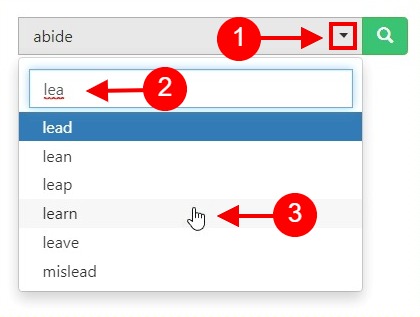
Alla ricerca di un determinato verbo irregolare?
Usate la ricerca (filtro)